


CCD (charge coupled device)
• Charge Coupled Device.
• It is a charge transfer device.
• CCD is a shift register formed by a string of closely placed MOS capacitors.
• It stores and transfers analog signals which are generated electrically or optically.
Construction
• Series of metal gate electrodes separated from a p type substrate (if N channel).
• On top it SiO2 an array of metalized electrodes are placed which are connected to various voltages V1, V2,….
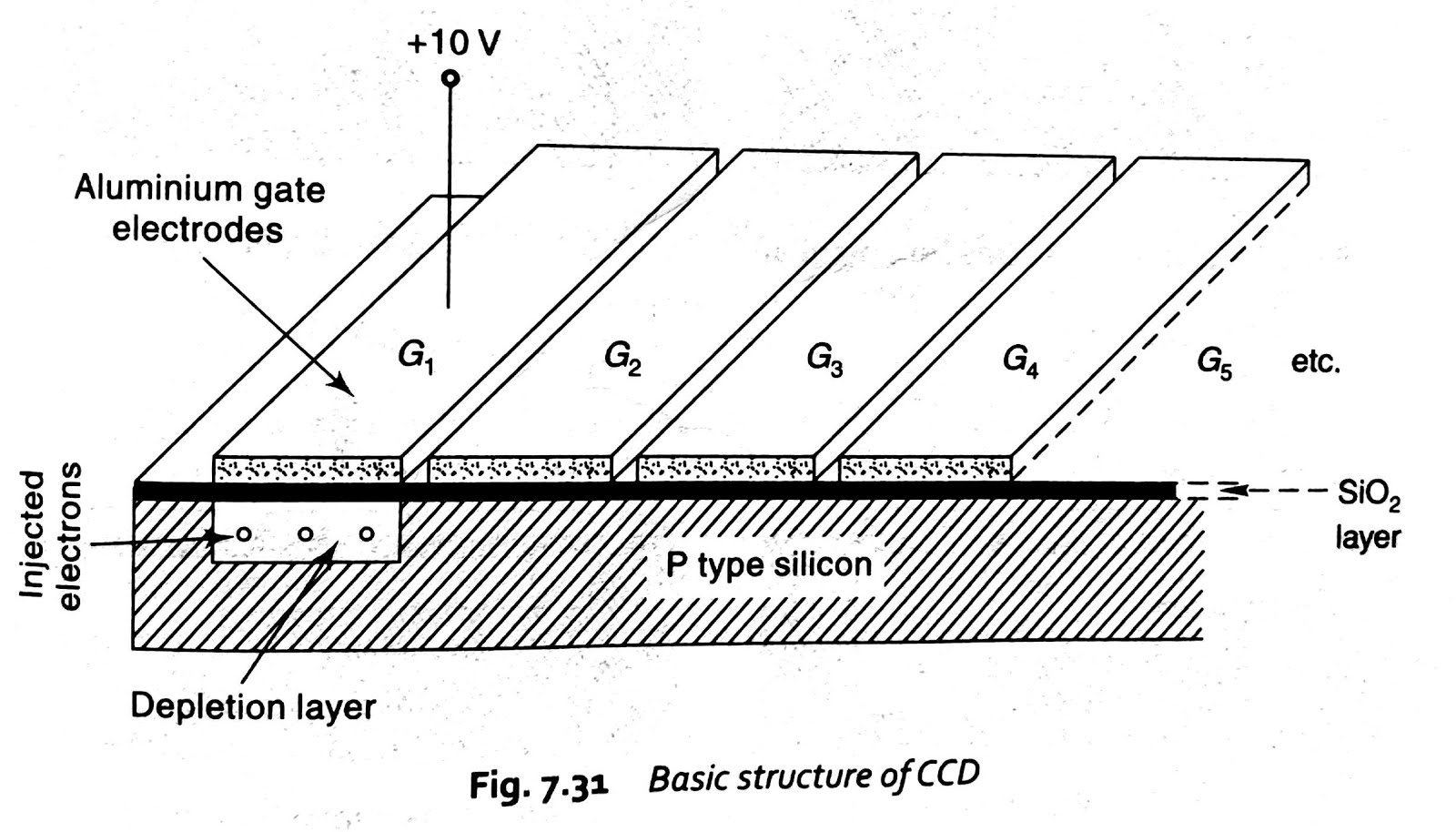 |
| CCD Structure ( pic courtesy: Electron Deviecs By Salivahanan) |
Operation
• 3 phase clock is applied to CCD
First Phase
• A positive voltage V1 (10 V) is applied to G1.
• V1>V2,V3 so a depletion region is formed in less than 10microsecs.
• A potential well is formed where the minority charge carrier is stored (electrons).
Second Phase
• The adjacent gate G2 is biased with higher voltage (15V)
• A deeper well is created and the stored electrons moves into it.
• This process is relatively slow.
• To ensure transfer of charge the potential gradient must overlap. This can be done by keeping the distance between the gates as small as possible.
Third phase
• The charge on g1 and G2 can be slightly relaxed and G3 is given with 15V.
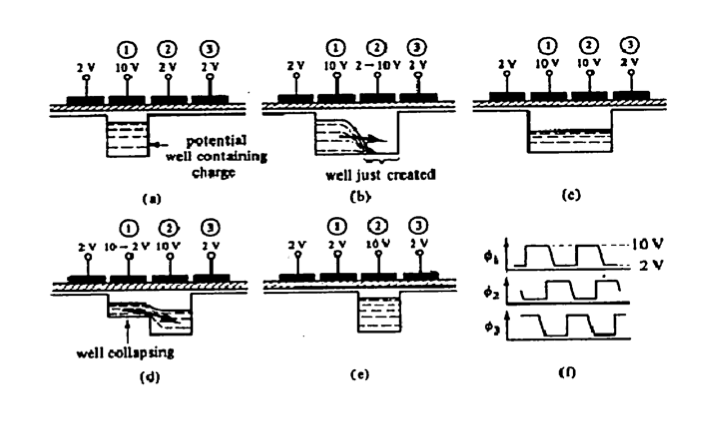 |
| CCD Operation (pic Courtesy:Vik Dhillon) |
• Electrons are further transferred inside.
• Thus the charges has been transferred in one cycle of 3 phase.
• So one cycle of transfer can store one bit
• As charge or cycle moves to next gate G3 to G4 it is ready to receive the next bit.
Characteristics
• CCD behaves like a dynamic shift register.
• Charge has to be transferred in less than 1ms.
• Inversion has to take place very soon else the charge will be disappeared and information is lost.
Applications
• transfer speed 20 MHz
• Dynamic shift register
• Solid state imaging(video camera)
• Photosensors
• Consumes very little power and is capable of operating at high frequencies.

 Jane's Blog